17 August 2026 · Jehan Legac
Is AI Killing Painting, or Saving It? What's Really Happening Inside Artists' Studios
The auction houses are placing bets, the galleries are split down the middle, and collectors are quietly rewriting what “authentic” means. A look at the numbers, the mood, and the artists caught in between.
Ask ten people in the art world what they think about AI right now, and you’ll get ten different answers most delivered with more conviction than the topic has actually earned. It’s the most divisive question in contemporary art today, and 2026 is the year the industry stopped being able to look away from it.

One of Legac’s recent AI-generated pieces
The Split
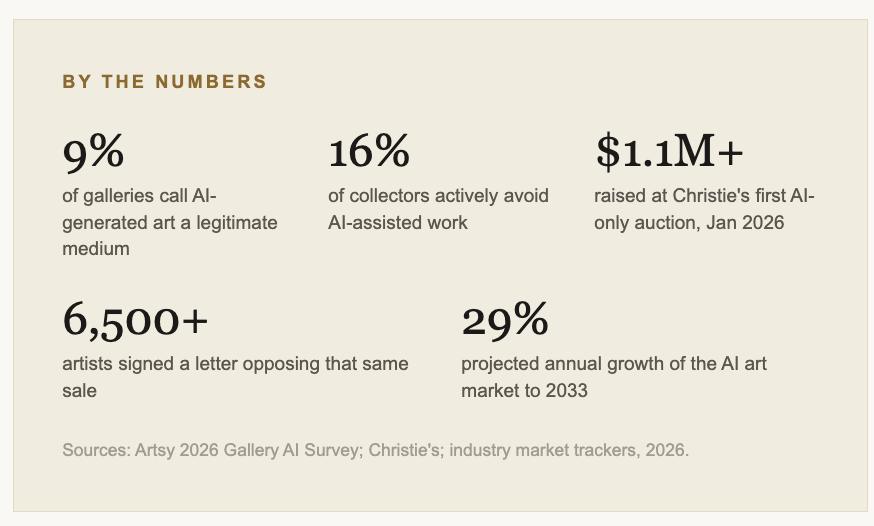
Start with the galleries, because they’re the ones standing between artists and the market. Artsy’s 2026 survey of more than 300 galleries found that only 9% consider AI-generated art a legitimate medium in its own right. Collector appetite tells a similarly cool story: 41% of galleries say AI “rarely comes up” in conversations with buyers, and 16% report that collectors actively avoid work made with the technology’s assistance. Only 15% describe any real curiosity-driven interest.
And yet, the money is unmistakably moving. In January 2026, Christie’s ran its first major AI-only auction, “Augmented Intelligence,” pulling in more than $1.1 million — even as six of the 34 works went unsold, and more than 6,500 artists signed an open letter demanding the sale be cancelled outright. A few months later, artist Refik Anadol opened Dataland, the first museum built specifically around generative and AI-driven work. One market analysis this year put AI-related lots at roughly 35% of fine art auctions, with the category’s value projected to grow by around 29% a year through 2033.
The Human Premium
Here’s the twist that doesn’t fit neatly into either side of the argument: the more capable AI-generated imagery becomes, the more collectors seem to want proof of a human hand. Market watchers are calling it the “human premium” an emerging pattern where buyers pay more for work that visibly carries a person’s decisions: a brushstroke that wanders, an odd crop, a color choice that shouldn’t work but does. Younger collectors in particular are gravitating toward accessible, human-made work and buying directly from artists, often asking to see process, sketches, studio documentation, the evidence of a decision being made before they buy.
“The market isn’t rejecting the tool. It’s rejecting the disappearance of the hand.” — Sara, Artist Management
What I’m Seeing
I sit on the business side of an artist’s career fairs, studio visits, conversations with galleries and collectors and the pattern above matches what I hear in the room, not just what shows up in a survey. Questions about AI used to be about ethics in the abstract. Increasingly, they’re practical: how was this made, and will you tell me. Collectors aren’t asking artists to promise they didn’t use the technology. They’re asking for honesty about whether they did, and for enough of the process to still be visible that the answer feels like it matters.
That’s a more useful distinction than “for or against.” In practice, disclosure is becoming the real currency not the tool itself.
So Which Is It?
Probably neither, cleanly. AI isn’t killing painting, the human premium data argues the opposite, if anything. And it isn’t quietly saving it either; too many galleries remain unconvinced, and too much of the current AI-only auction activity still reads as speculation rather than lasting demand. What the technology does seem to be doing is sorting the market: rewarding artists who are transparent about process and clearly still present in the decision-making, and leaving behind work that reads as generated rather than made.
It’s a pattern that shows up even among artists who use AI as one tool among several rather than avoiding it altogether painter Jehan Legac’s hybrid practice, which fuses oil technique with digital and AI-assisted elements, is one working example of that disclosed, hand-still-present approach. But the broader story here isn’t about any one artist. It’s about a market recalibrating, in real time, what it actually wants to pay for.
What’s your read does the tool matter, or only what survives of the artist inside it? More of this conversation, and the work behind it, lives at jehanlegac.com and on Instagram @jehanlegacart.