The Space That Shapes The Work
- Jehan Legac

- May 4
- 2 min read
On scale, presence, and the physical experience of standing before Jehan Legac's work.

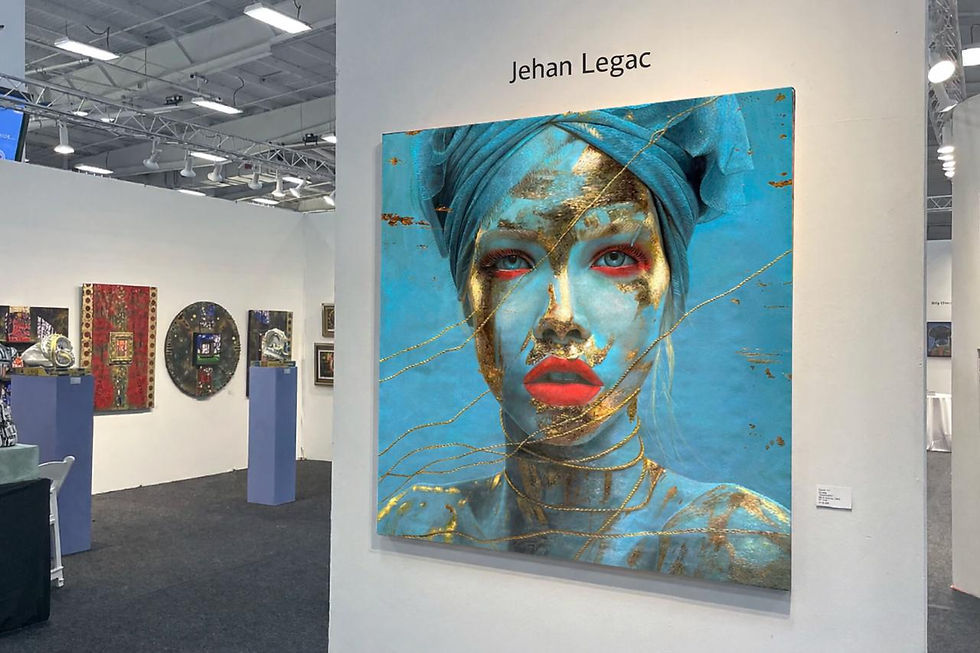
A 150 × 150 cm canvas does not offer itself to the eye the way a smaller work does. It cannot be taken in from a single position, at a comfortable distance, with the arms crossed. It requires the body to negotiate: to step back, to move closer, to tilt the head. The experience is physical before it is intellectual.
This is a deliberate condition in Jehan Legac's practice. The figures painted at near life-scale are not large for the sake of spectacle. Scale here is a tool for a specific kind of encounter: the painting occupies almost the same space as the person standing before it, and that proximity changes the nature of attention.

The work is made in natural light, which means the surface reads differently across the hours of a day, and Jehan works with that variability rather than against it. What appears resolved at noon may open again by late afternoon. That sensitivity to light is built into the finished canvas: the skin tones, the way shadow sits against the edge of a figure, the particular warmth or coolness of a background.
The figures themselves hold a quality of stillness that is not passivity. They are present in the way that only large-format work can sustain, with enough surface area to contain silence, tension, and detail simultaneously. Standing before one of these paintings, the eye has nowhere to rest that is not intentional.
That quality of presence, the sense that a work holds the room it inhabits, becomes something else entirely when the space is built for it. Jehan's paintings were always made to be seen with room around them, in spaces where the architecture answers the scale of the work. A new exhibition is taking shape in a new gallery space. Details soon.

Comments