ประวัติ
Jehan Legac
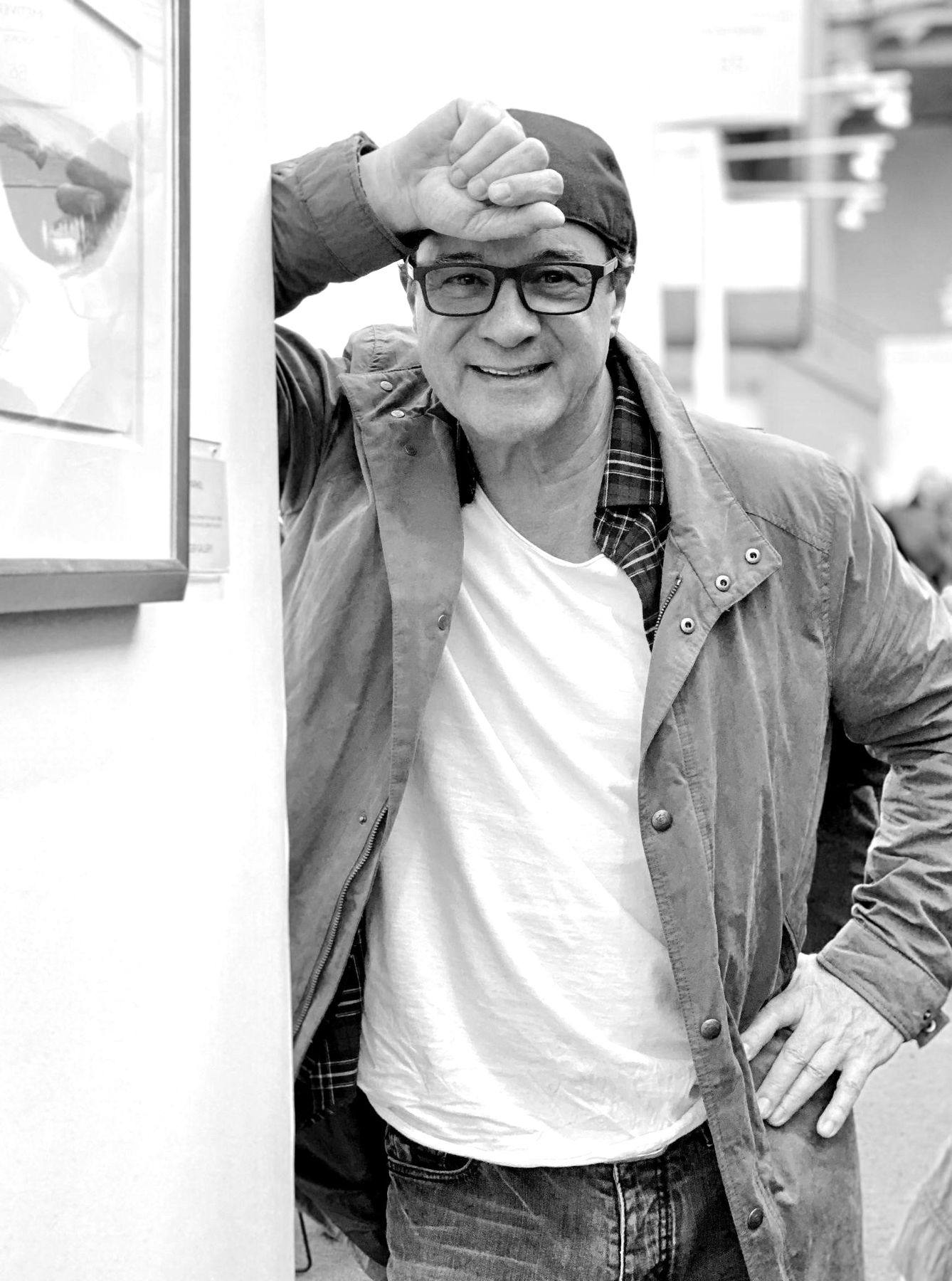
Jehan Legac is a French visual artist whose practice spans five decades of photography and painting.
Born in Paris, at fourteen he received a Yashica camera from a father he barely knew — separated parents, distant presence.
The unexpected gift, received as an offering, became the starting point of a vocation: the desire to do well, not to disappoint that absent figure. He made his first paid photographs at fifteen, documenting cats on the rooftops of Paris for a photo agency, then producing expertise records for hardstone collections for insurance appraisals. He photographed his sister, and gradually discovered that the female form would be his subject — the one he would carry first to the lens, then to the brush, throughout his life.
In 1974, he was appointed personal photographer to Admiral Philippe de Gaulle within the French Navy — a mission that took him from the North Pole to tropical islands and offered him an exceptional visual education: extreme light, official portraiture, the discipline of documentary imagery.
In 1984, he moved to New York, where he expanded his practice into fashion photography and three-dimensional design. Miami and Los Angeles would then punctuate his path.
In the late 1990s, he acquired a house in Ibiza — La Falaise — which would become the site of his revelation as a painter. The dwelling had once housed the studio of Elmyr de Hory, a painter of considerable talent who became, over time, one of the most celebrated art forgers of the twentieth century and the central figure of Orson Welles and François Reichenbach’s F for Fake — part of which was filmed in the house itself. Sleepless night after sleepless night, carried by the charged atmosphere of the studio and by the free-spirited Ibiza of that era, Jehan Legac found himself painting until dawn — as if guided by a hand that was not quite his own. Each morning, discovering the canvases of the previous night, he did not fully recognise the painter he was becoming. The cycle repeated itself over several years, gradually revealing a pictorial practice that eventually took precedence over the rest.
Since the early 2000s, oil painting has asserted itself as the culmination of his visual research. In 2005, he discovered Asia through an art fair in Beijing at the invitation of NY Art Magazine, then explored Shanghai, Manila and Bangkok. He gradually adopted a rhythm shared between Europe and Asia — six months in Ibiza, six months in Bangkok — before establishing his principal studio in Thailand. He is currently planning a presence in Hong Kong.
Six successive series — assembled in a consolidated portfolio — trace the evolution of a practice devoted to the female form: from the expressive nudes of the beginnings (Nude Geometry, 2002; Essence Unseen, 2007–2010), through an exploratory cycle (Neo Horizon, 2020–2021), to the contemplative and symbolic portraits of today (Aqua Veil, 2022–2023; Held Breath, 2024; Threads of Eternity, 2025).
Since 2024, he has integrated generative artificial intelligence tools into his practice as a space of transformation for his personal photographic archive. His practice now articulates three disciplines: fifty years of photography, AI as a laboratory of exploration, and oil on canvas as the manual gesture of completion. He situates his work in the lineage of painters who, from Warhol onwards, have made the technical image the primary matter of painting.
The recent works explore the feminine as contemplative presence — veiled, fragmented, suspended between portrait and icon. Large format (up to 150 × 150 cm), the blue-gold-flesh palette, gold leaf and the treatment of veils constitute the recognisable vocabulary of his painting.
He is preparing the launch of a monograph scheduled for 2027.
แถลงการณ์
My practice unites two disciplines I have pursued in parallel for five decades: photography and painting. From my first cameras in Paris in the 1970s, through photographic missions conducted for the French Navy under the command of Admiral Philippe de Gaulle — from the North Pole to tropical islands — and later in New York and in every capital I have inhabited, the image has remained my language.
I loved photography because it offered mastery of the instant: a thousandth of a second is enough to seize a light, a gaze, a smile, an anguish, a danger that will never again appear before my eyes in quite the same way. But a photograph rarely lives more than seventy years, and this fragility troubled me for a long time — those patiently captured instants were condemned to fade with their support. Oil painting on canvas, by contrast, can cross the centuries. To share, generations from now, an emotion sealed today in the silence of a studio gives to my natural generosity a pleasure no silver image will ever grant me. It is this desire for duration that led me to painting.
Today I paint the female form in oil on canvas, in large formats. But before the brush meets the linen, a darkroom of a new kind comes to life. For nearly two years now, I have used generative artificial intelligence as a laboratory — a space in which my own photographs, accumulated over decades, are reworked, transformed, hybridised with my intuitions of the moment. AI is neither the author nor the work: it is a tool, as the analog camera was before it. It demands mastery, dialogue, direction — an eye that knows what it seeks.
What appears on the canvas — these veiled faces, these silhouettes suspended between presence and absence, this dialogue between deep blue and gold leaf — emerges from a patiently built visual memory. I situate my work in a lineage that, from Warhol to Richter, from Chuck Close to David Salle, has made the technical image the very matter of painting. The manual gesture remains central: each work is a painted object, in oil, in a centuries-old technique.
I seek to bring forth, in silence, a female figure that escapes narrative — a presence that speaks without words, half portrait, half icon, offered to whoever will discover it, today or three hundred years from now.